Moving Off Avaya: How to Decide, and How to Choose if You Do

Test what your current estate can still carry, then compare platforms on requirements rather than demos.
Most Avaya conversations start the same way. Someone asks which platform to move to, and within a week there are three vendor demos in the calendar and a comparison grid nobody trusts.
The question is reasonable, but it often comes too early. Before choosing a replacement, establish whether what you want next requires one, since the answer changes both the shortlist and the timing.
Plenty of Avaya estates do need to move. Others have more room than they think, particularly when the next ambition is an AI capability rather than a change in call routing. Find out which situation you are in first, and let that shape the platform decision.
Start with what you want next, not with what you run
A selection that begins with the incumbent tends to produce a like-for-like replacement: a more modern version of what you already have, with the capability that prompted the exercise arriving eighteen months later as an unbudgeted phase two.
Beginning with the ambition works better. An agentic voice agent on your highest-volume intent is a specific requirement that can be tested against your current estate. Where the environment exposes an open telephony path, through SIP trunking, bring-your-own-carrier or SIP REFER, a third-party agent can often be inserted without replacing the platform underneath it.
This removes artificial urgency, since the capability no longer waits on a cutover. It also shows what your call path, integrations and compliance controls will tolerate before you commit to a multi-year program.
Sometimes the test comes back negative: the architecture is too closed, the platform cannot carry the concurrency, or the security posture does not survive review. That is still a useful answer, because it turns the migration case from a preference into a documented finding you can take to a board.
The wider evidence supports testing first. Gartner expects more than 40% of agentic AI projects to be canceled by the end of 2027, citing escalating costs, unclear business value and inadequate risk controls, and Deloitte’s reading of that research points to legacy system incompatibility as one of the drivers. Deloitte’s Tech Trends 2026 reports that 14% of organizations have production-ready agentic AI and 11% are running it. These are market signals rather than predictions about your estate, but they favor measuring the environment first.
Inventory what has to survive
An Avaya estate that has run for years holds a great deal that is not written down. The inventory is straightforward work, and it often separates a calm migration from a difficult one.
Routing and call flows. What is live today, including exceptions added over the years for a particular queue, season or customer.
IVR assets and prompts. Recorded prompts, languages, the business rules behind menu behavior, and the logic that only surfaces when a caller takes an unusual path.
Integrations and custom logic. CTI screen pops, CRM lookups, middleware and older scripts. Each is a dependency, and its owner may no longer be with you.
Agent workflows. How the desktop is used in practice, workarounds included. Migrations that reproduce only the documented workflow tend to lose handle time on day one.
Recording, compliance and reporting. What is captured, how long it is kept, what regulators expect, and which historical reports the business would miss.
Support timelines, verified. Confirm end-of-support dates at product and version level for your estate, along with contract terms and available migration incentives. General statements about a vendor’s direction are not a substitute.
Build the comparison from your own requirements
If the evidence says move, build the comparison from your operating requirements rather than vendor feature lists. Most platforms satisfy most of a generic checklist, so such checklists rarely separate them.
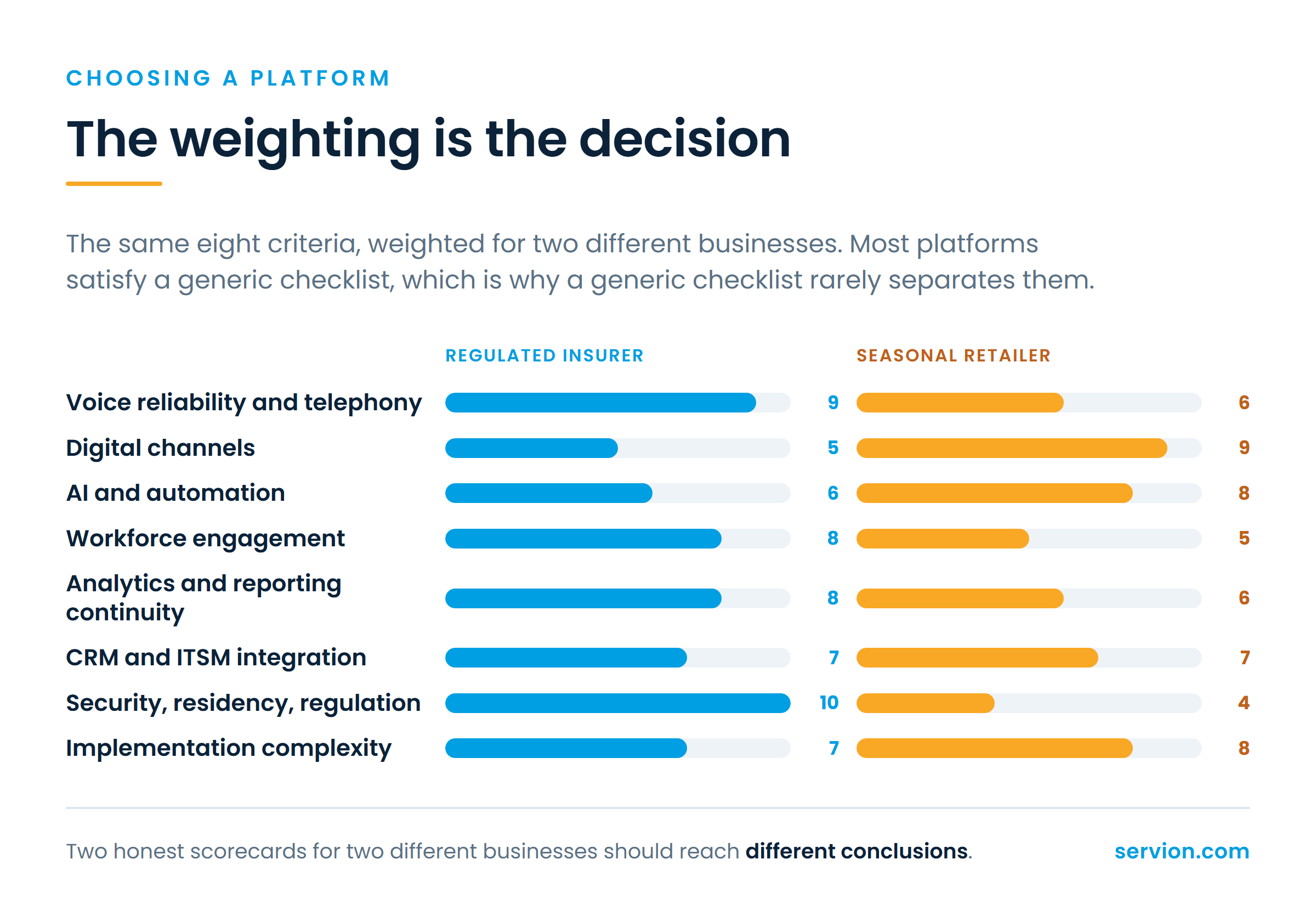
A requirements-led scorecard weights the criteria that matter in your environment: voice reliability and telephony architecture, digital channels, AI and automation (native or partner-delivered), workforce engagement, analytics and reporting continuity, CRM and ITSM integration, security, data residency and sector regulation, and implementation complexity, where optimistic timelines usually go wrong.
The weighting carries the decision. A regulated insurer with heavy outbound and a large offshore workforce will weight these differently from a retailer with seasonal peaks and a small in-house team, and their scorecards should reach different conclusions.
Genesys Cloud CX, NICE CXone, Cisco Webex Contact Center, Zendesk Contact Center and Amazon Connect all appear regularly on Avaya replacement shortlists, and each tends to suit a different kind of organization. Treating them as fit patterns rather than a ranking keeps the exercise credible.
The economics that actually decide it
Subscription price is the number that arrives first and explains the least. A business case that stops there will be wrong by a wide margin, often in a way that becomes visible around month nine.
The lifecycle view includes licensing, telephony and carrier costs, infrastructure, maintenance, integration rebuild, migration services, internal labor across IT and operations, training, parallel running and post-go-live optimization. It should also carry the cost of the roadmap you delay while the migration runs, even though no invoice shows it.
The attach option has its own economics. If a capability can be delivered on the current estate, you compare the fully loaded cost of moving against the cost of the capability alone, and defer the platform decision until you know more.
Migrate in waves, and prove one wave first
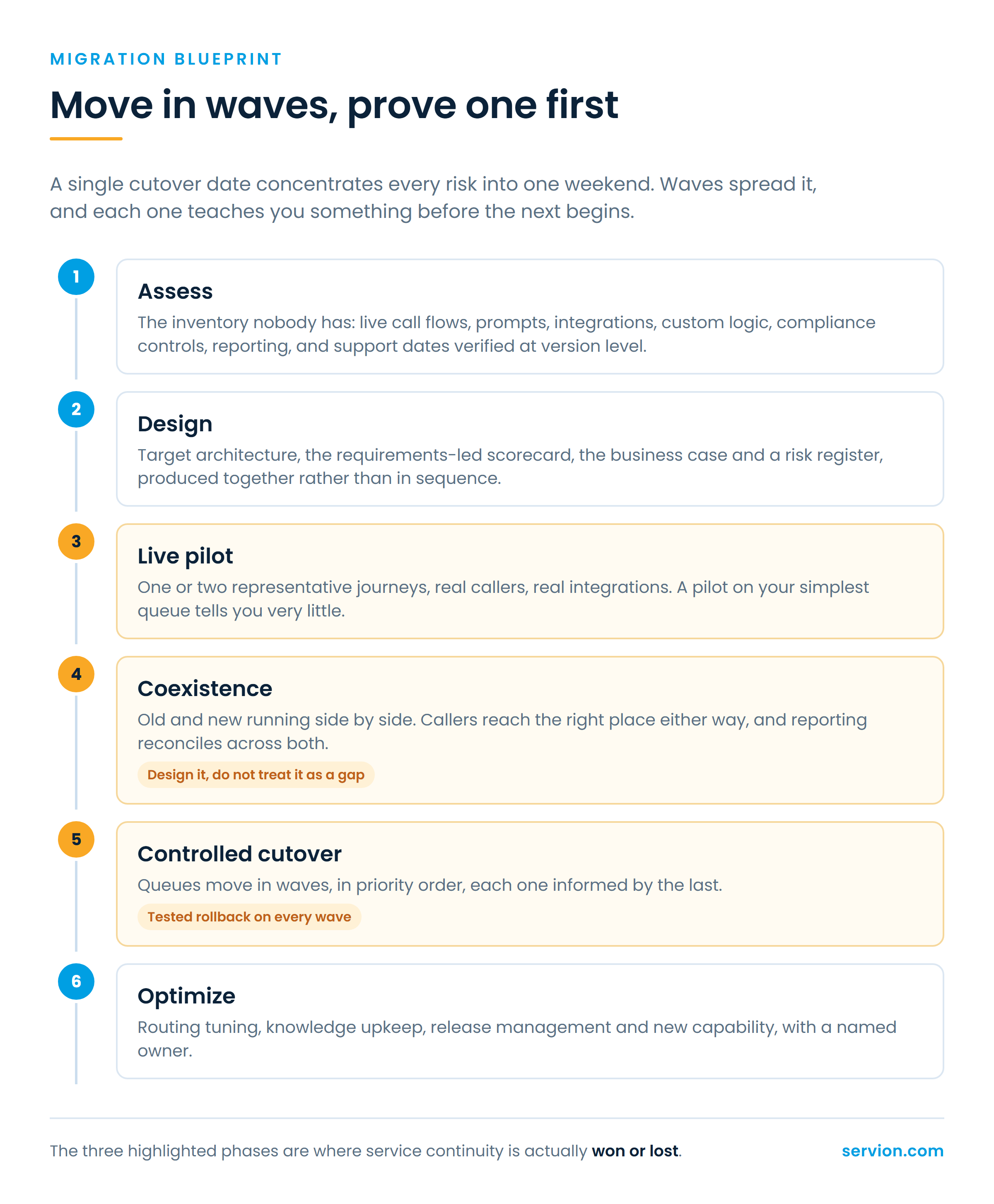
A single cutover date concentrates the risk into one weekend. Waves spread it, and each one teaches you something before the next.
The sequence that tends to hold is an assessment that produces the inventory and target architecture, a live pilot on one or two representative journeys, a period of coexistence, controlled cutover in priority order, and optimization once volume is stable.
Two points are worth insisting on. The pilot has to be live, with real callers and integrations, because a sandbox pilot mostly proves that the sandbox works. And every wave needs a tested rollback path, since the moment you need it is a poor time to find out whether it works.
A good pilot answers what the paper exercise could not: whether the routing logic survived translation, whether the screen pop carries the right record, what handle time looks like when agents work in an unfamiliar desktop under real pressure, and whether key business reports can be reproduced. Choose representative journeys over easy ones, since your simplest queue will tell you little about the queues that matter.
Coexistence holds much of the engineering difficulty. Callers have to reach the right place whichever platform holds their journey, reporting has to reconcile across both, and agents may work in two environments for a while. It deserves deliberate design rather than being treated as a gap between phases.
Plan the run-state before you sign
Platforms do not improve on their own. After go-live, someone will be tuning routing, updating knowledge, managing releases, watching integration health and adding capability as the business asks for it.
Deciding that ownership during selection changes what you buy. It raises questions about release cadence, how much of the AI work needs a specialist, and whether your internal team has the capacity the business case assumed.
The decision, in order
Establish what you want the contact center to do next. Test whether your current estate can carry it, and record what you find. If it can, you have gained time and evidence. If not, you have a migration case built on something more solid than a feature comparison.
Then choose on weighted requirements, cost the whole lifecycle, move in waves with a tested rollback, and decide who owns the result before you sign.
Servion’s JourneyWorCX Discovery + LaunchPad for Avaya environments delivers the inventory, platform scorecard, target architecture, business case, risk register and a live pilot in one controlled engagement, followed by implementation and Servion Managed Services. Request an Avaya environment assessment and a personalized CCaaS comparison →
ABOUT THE AUTHOR
Kamalanathan M. is VP & Global Head of Delivery with 25 years in CX delivery across Cisco, Genesys, NICE CXone, Amazon Connect, and Google CCAI, he specializes in AI-led automation that makes customer experience transformation both scalable and profitable.