Go-Live Is Day One: The Operating Model for Compounding CX AI ROI

How continuous tuning, governance and expansion keep a successful deployment from becoming an isolated pilot.
The first use case goes live and it works. Containment improves, the transcripts read well and the program is declared a success. Everyone celebrates.
Six months later it handles slightly less volume, two intents have drifted after a policy change, no third use case has been added, and the person who knew the integration has moved on. No status report flags it, because keeping it sharp has drifted off everyone’s radar.
Research points the same way. Gartner predicts that more than 40% of agentic AI projects will be canceled by the end of 2027, citing escalating costs and unclear business value, while Deloitte’s Tech Trends 2026 finds 14% of organizations with a production-ready agentic solution and 11% running one. How deployments are run after go-live often explains more of that gap than the technology.
The go-live proves the use case is effective. What happens in the following quarter determines if the AI investment will fail or grow.
Decide who owns the outcome, not just the platform
Most deployments that struggle have clear ownership of components and unclear ownership of results. IT owns the platform, operations the queue, a vendor the model, and whether the solution still delivers what the business case promised belongs to nobody.
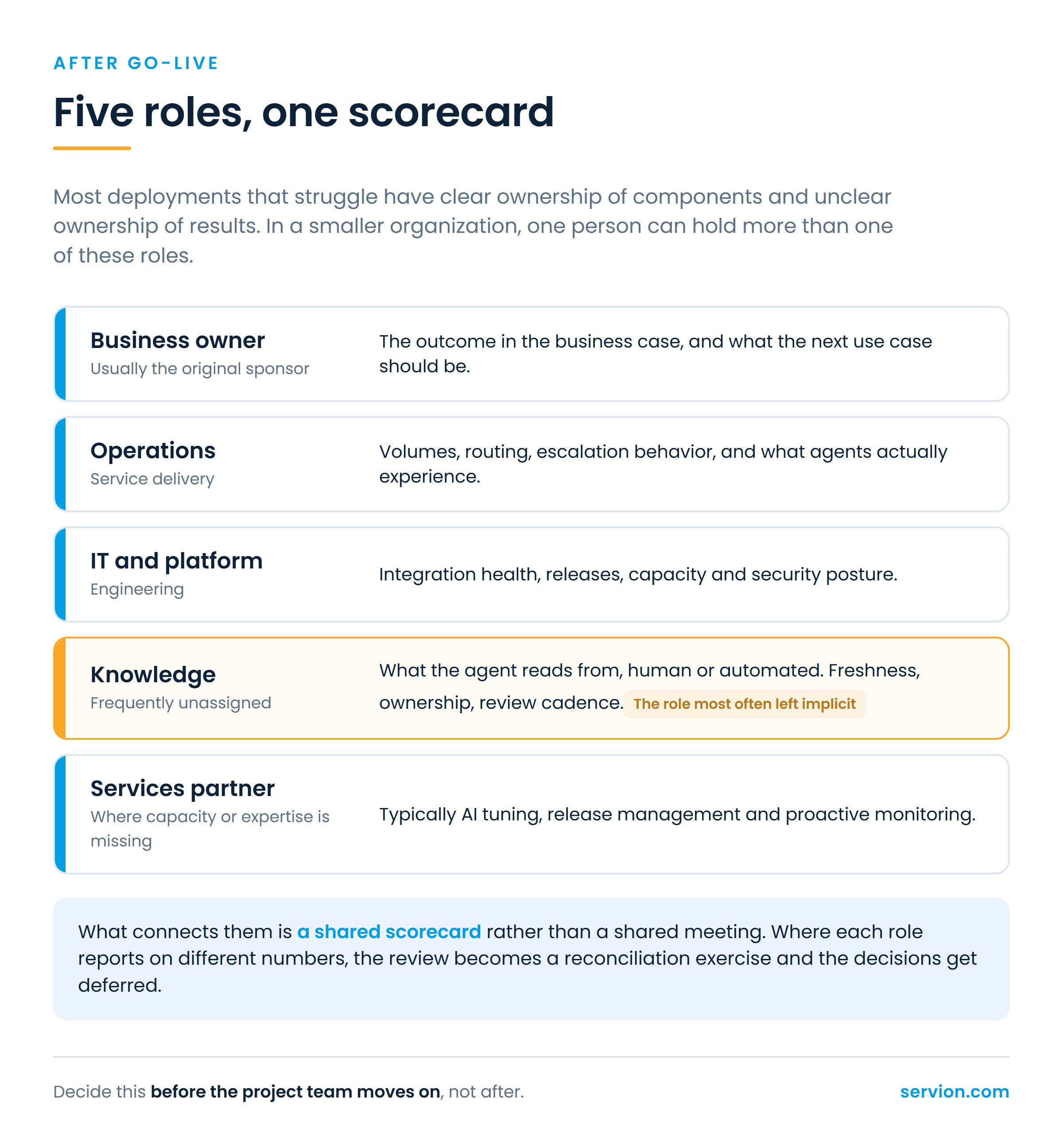
The run-state works when five roles are named, even if one person holds several in a smaller organization.
Business owner. Accountable for the business case outcome and the next use case, usually the sponsor of the original investment.
Operations. Owns the daily service picture: volumes, routing, escalation behavior and what agents are experiencing.
IT and platform. Owns integration health, releases, capacity and security posture.
Knowledge. Owns what human and automated agents read from. This role is most often left implicit, and its absence shows up as answer drift within months.
Services partner. Owns what the internal team lacks the capacity or expertise to hold, often AI tuning and release management.
A shared scorecard connects them, since separate numbers turn the review into a reconciliation exercise.
Give optimization a rhythm
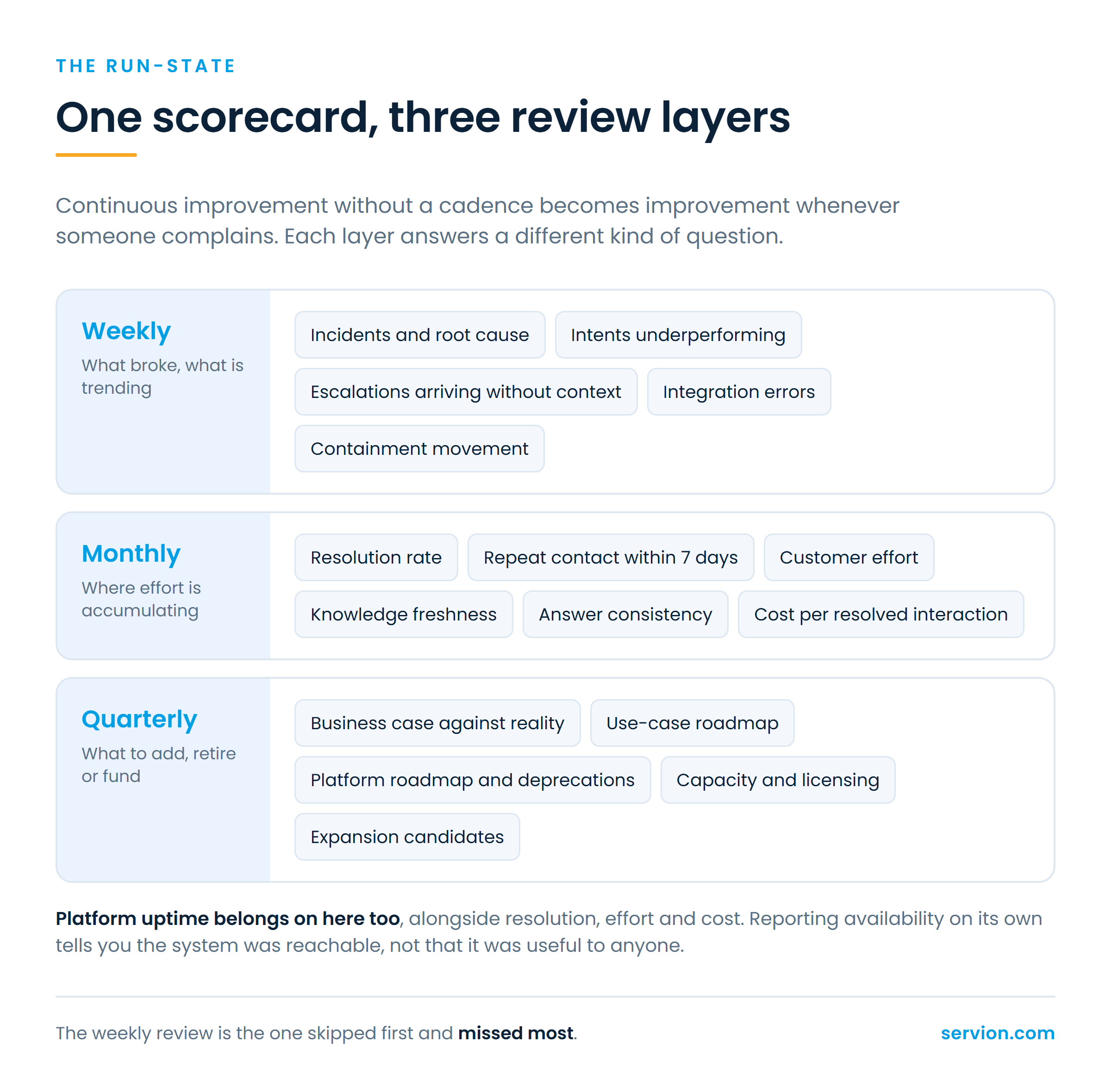
Without a cadence, improvement tends to happen whenever someone complains. A rhythm that holds up has three layers.
Weekly, operational. What broke, what is trending, which intents underperform and which escalations lacked context. Short, with operations and the partner, covering the last seven days.
Monthly, analytical. Trends rather than incidents: where effort accumulates, whether the most-read knowledge is current, why containment moved, and what repeat contact says about recorded resolutions.
Quarterly, directional. Use cases and roadmap: what gets added or retired, what the next investment should be, and whether the business case still describes reality.
Organizations often skip the weekly review first and miss it most, because it catches drift while correction is still easy.
Govern the knowledge, not only the model
Model tuning gets the attention, but knowledge governance usually decides whether answers stay correct, and knowledge decays quietly.
A policy is revised, a product is withdrawn or a fee changes, and the agent keeps citing the previous version with the same confidence. The first indication is often a complaint, by which point the answer has been given several hundred times.
The solution is not complicated. Keep one governed source with a named owner and a review cadence set at design time, feeding both automated and human agents so they never contradict each other. Set explicit boundaries on what the agent may do as well as say, because an action in a system of record is harder to walk back than a sentence. And define low-confidence behavior, which usually means handing over with context.
Quality review should apply one standard to automated and human interactions, or you cannot compare whether customers’ problems were solved.
Run the platform like production
Once a voice or digital AI agent is in the customer path, it is a production solution, and it behaves like any other production system that people depend on.
That means proactive monitoring of the platform and the integrations, since most incidents surface at a seam: an API that slowed down, a certificate that expired, a permission that changed during an unrelated release. It means release management with a tested rollback, because upstream platforms ship on their own schedule and a partner release can alter behavior you did not anticipate. It means capacity planning against the busiest hour rather than the average, and security patching that does not wait for a quarterly window.
It also means watching the platform vendors. Roadmap changes, deprecations and end-of-life dates on the underlying estate, whether Genesys Cloud CX, NICE CXone, Cisco and Webex, Zendesk Contact Center or Amazon Connect, land on your service whether or not anyone internally was tracking them.
Make the second use case cost-effective
Sometimes a first deployment stays a first deployment because it failed. More often, the second use case would have required as much work as the first, and it never got funded.
This occurs when nothing was built to be reused. Where the integration pattern, knowledge structure, governance model, deployment models, testing approach and support structures were designed once and treated as assets, each additional use case costs a fraction of the original, and the argument for the next one gets easier.
Prioritizing the queue is its own discipline. Volume and boundedness make a use case cheap to automate. Business impact makes it worth automating. The two do not always point at the same thing, and the evidence for both sits in the interaction data from the use case already running, the most reliable input available, and the one most often ignored in favor of a workshop.
Expansion also runs along axes other than new intents. The same knowledge layer can serve agent assist alongside self-service, and a working design can move to another channel, business unit or geography. Each carries less risk than a new intent, and each makes the original investment look better.
Where the value compounds
The organizations that compound value from CX AI tend to share a few traits: somebody owns the result after go-live, there is a rhythm for reviewing it, the knowledge is governed, and the second use case was made cost-effective by how the first one was built.
None of that shows in a demo or costs much relative to the original deployment. It is mostly a decision about who is accountable once the project team moves on, best made before it does.
Servion’s Engage360 and managed services take on that run-state: monitoring and platform health, AI and knowledge tuning, release management, quality review across automated and human service, KPI reporting against the business case, and a roadmap for the use cases that follow.
ABOUT THE AUTHOR
Mike Pietig is the Vice President of Client Success at Servion, where he leads a global team focused on client outcomes, satisfaction, and long-term value realization across industries.