There Are 1,600+ Conversational AI Vendors. Where Do You Start?

Your CEO just read another article about agentic AI transforming customer service. Your board wants a plan by next quarter. Your team has been tasked with evaluating vendors
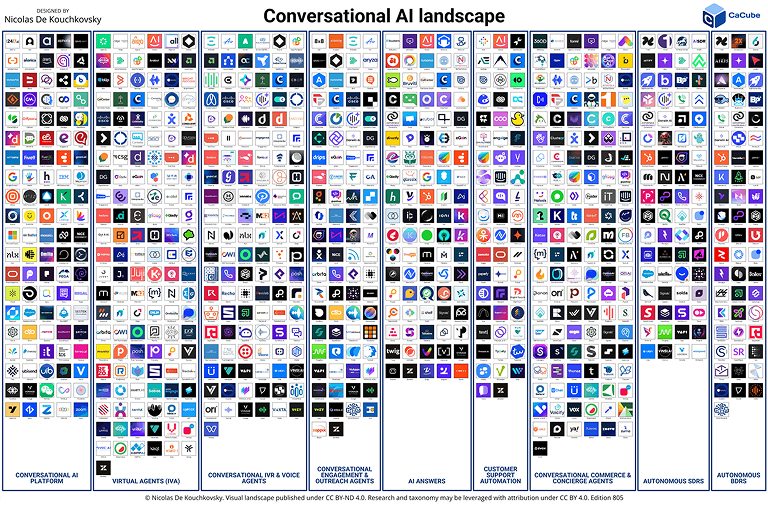
You open your browser, start searching – and discover there are over 1,600 conversational AI vendors in the market.
The paradox is real: the technology has never been more promising, but the vendor landscape has never been more overwhelming. And the stakes have never been higher. Industry data suggests that 60-80% of enterprise AI projects fail to deliver expected ROI. For CX leaders under pressure to move fast, choosing the wrong vendor doesn’t just waste budget – it burns organizational trust in AI and sets the transformation back by years.
This article provides a practical framework for navigating the conversational AI vendor landscape – from narrowing the field to deploying your first agentic AI use case with measurable ROI in 60 days.
The Agentic AI Moment: Why the Pressure Is Real
Contact centers are at an inflection point. The convergence of large language models, autonomous agent frameworks, and improved speech-to-text capabilities has created a fundamentally new category: agentic AI. Unlike traditional IVR or rules-based chatbots, agentic AI systems can reason, adapt, and execute multi-step tasks without rigid scripting.
The market has responded with explosive growth. Venture capital has poured billions into conversational AI startups over the past 24 months. Established CCaaS platforms have bolted on AI capabilities. And a new wave of specialized vendors has emerged, each claiming to solve a specific slice of the customer service puzzle.
For CX leadership, the pressure from above is intense. Boards see competitors deploying AI agents and want results – fast. McKinsey estimates that AI in customer care can increase productivity by up to 45%, while reducing costs by 20-30%. But realizing that potential requires choosing the right technology – and that’s where most organizations get stuck.
Why Most Agentic AI Deployments Fail
Mistake 1: Starting with the Vendor, Not the Use Case
The most common failure pattern: a CX team sees an impressive vendor demo, gets excited, signs a contract – and then tries to figure out where to apply the technology. This backwards approach leads to solutions looking for problems, pilots that demonstrate technical capability but not business value, and deployments that never scale beyond the proof of concept.
Mistake 2: Evaluating Too Many Vendors (or Too Few)
With 1,600+ options, some organizations attempt comprehensive evaluations that take 6-12 months and exhaust the team before a single agent is deployed. Others default to their existing platform vendor’s AI add-on without evaluating whether it’s the best fit.
Both approaches carry significant risk. The first loses time when speed matters most. The second sacrifices quality for convenience.
Mistake 3: Underestimating Integration Complexity
Agentic AI doesn’t operate in isolation. It needs to integrate with your existing contact center platform, CRM, knowledge bases, authentication systems, and compliance frameworks. A vendor that demos beautifully in isolation may struggle to deliver within the constraints of your actual architecture – especially in regulated industries like financial services, healthcare, or insurance.
Mistake 4: Voice Latency
One often-overlooked dimension of integration complexity is voice latency. A chatbot that performs well in text-based interactions may not translate to voice. Voice needs to be real-time and is extremely latency-dependent – a chatbot converted to a voicebot may not be designed for the high responsiveness that callers expect. Too much latency destroys the experience, turning what should feel like a natural conversation into an awkward, frustrating exchange.
From 1,600 Vendors to 9: How We Narrowed the Field
At Servion, we’ve been deploying contact center technology for over 30 years across 600+ implementations for some of the world’s most complex CX environments. When the agentic AI wave hit, we recognized that our clients needed more than a recommendation – they needed a rigorous, vendor-agnostic evaluation they could trust.
- Deployment readiness: Can this vendor deliver a production-grade solution in 60 days, not 12 months?
- Enterprise integration: Does it work with Genesys, NICE, Cisco, and other platforms our clients already run?
- Regulated environment compliance: Can it handle BFSI, healthcare, and insurance requirements out of the box?
- Conversation quality: How well does the AI handle nuance, context switching, escalation, and emotional intelligence?
- Scalability and reliability: Can it handle enterprise-scale volumes with the uptime requirements our clients demand?
- Total cost of ownership: Not just license fees, but implementation, maintenance, and ongoing optimization costs.
1,600+ vendors evaluated. 9 made the cut. Want to know which ones – and why? Contact our team for the full shortlist.
The result: we narrowed the field to 9 vendors that we believe can deliver successful deployments across the primary use cases our clients need. These aren’t the vendors with the best marketing – they’re the ones that perform when the complexity is real. Want to know which nine made the cut – and why? Reach out to our team to learn about our evaluation methodology and shortlist.
The Four Questions Every CX Leader Should Answer First
Before you evaluate a single vendor, you need clarity on four critical questions. Getting these wrong is the primary reason agentic AI projects fail to deliver ROI.
1. Which use cases will deliver the most value in your environment?
Not all AI use cases are created equal. The right starting point depends on your specific contact center dynamics: call volume patterns, top contact reasons, agent skill gaps, and customer journey friction points.
Common high-impact agentic AI use cases include:
- Intelligent call routing and triage – AI that understands intent before the call reaches an agent
- Caller identification and validation – Secure, frictionless authentication using voice biometrics and AI-driven verification
- Simple self-service automation – Password resets, account lookups, and routine transactions handled entirely by AI
- Agent assist and real-time coaching – AI that listens, summarizes, and suggests next-best actions
- Automated post-call work – Summary generation, disposition coding, and follow-up scheduling
- Customer self-service – Voice and digital AI agents that resolve issues end-to-end
- Proactive outreach – AI-initiated communications for appointment reminders, claim updates, or renewal opportunities
Key insight: The right starting point is the use case that matches your highest-impact pain point – and can demonstrate measurable ROI quickly.
2. Which vendor is best positioned to deliver for your specific use case?
Not every vendor excels at every use case. Some are strongest in voice AI, others in digital messaging. Some shine in highly regulated environments, others in high-volume retail. The right evaluation maps vendor strengths to specific use case requirements – so you’re not choosing the “best” vendor in the abstract, but the best vendor for your situation.
3. What does the business case actually look like?
“AI will save us money” isn’t a business case. A real business case quantifies: cost per handled contact today versus with AI, expected deflection or automation rates based on comparable deployments, implementation costs and timeline, and payback period.
The good news: the business cases we’ve seen recently have been compelling. In deployments we’ve supported, ROI has materialized in well under 6 months – driven by immediate reductions in average handle time, after-call work, and repeat contacts.
4. How will this integrate with your existing architecture?
Your contact center platform, CRM, workforce management system, quality monitoring tools, and compliance infrastructure all need to work together. The integration question isn’t just technical – it’s operational. How will workflows change? What training do agents need? How will you measure success?
Proving It Before You Scale: The 60-Day Deployment Model
One of the biggest lessons from the last two years of agentic AI deployments: enterprises that start with a focused proof of concept outperform those that attempt large-scale rollouts.
Servion’s JourneyWorCX Discovery+LaunchPad for Agentic AI is built on this principle. The engagement follows a structured 60-day model:
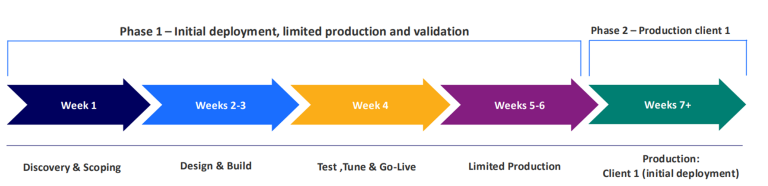
The outcome: hands-on evidence that the technology delivers operational and quality-of-service benefits in your environment, with your customers, at your scale. Not a vendor demo. Not a slide deck. Real results.
The Business Case for Speed
Time is not a neutral factor in the agentic AI decision. Every month of evaluation paralysis has a measurable cost:
- Competitor advantage: Organizations that deploy first capture efficiency gains and customer experience improvements that compound over time.
- Talent retention: Contact center agents facing burnout from repetitive tasks are more likely to stay when AI handles routine work and elevates their role.
- Cost accumulation: If AI can reduce cost-per-contact by 15-20%, every month of delay represents quantifiable waste.
- Technology evolution: The vendor landscape is consolidating rapidly. The evaluation you conducted six months ago may already be outdated.
The organizations seeing the strongest results aren’t those that spent the most time evaluating. They’re the ones that moved decisively with a structured approach, proved the concept quickly, and scaled based on evidence.
From Overwhelmed to In Control
The conversational AI vendor landscape is overwhelming by design. Every vendor has a compelling story, every demo looks impressive, and every sales team promises transformation.
The difference between organizations that succeed and those that don’t isn’t which vendor they choose. It’s whether they have a structured framework for making that choice.
Start with the use case, not the vendor. Narrow the field based on rigorous, real-world criteria. Build a business case grounded in your specific economics. Prove it works in your environment before you scale.
From vendor paralysis to deployed, measurable results in 60 days.

ABOUT THE AUTHOR
Bruce Eidsvik is Chief Growth Officer at Servion, where he leads go-to-market strategy and helps enterprise clients navigate the evolving CX technology landscape. With deep expertise in contact center transformation and vendor ecosystems, Bruce guides organizations from evaluation to deployment across some of the most complex CX environments in the world.